To choose a beverage premix supplier in the UAE, check four things in this order: valid food safety and Halal certificates, legal registration of the products for sale in the UAE, a blind sample test at your own doses, and commercial terms (minimum order, lead time, support). A supplier that passes all four can be trialled in one outlet before it goes chain wide.
What certificates should a premix supplier have?
Ask for copies, not logos on a website, and check the expiry dates.
- Halal certificate issued by a body registered with the UAE Ministry of Industry and Advanced Technology. You can look the body up in the MoIAT Halal certification body directory.
- ISO 22000 for the food safety management system of the factory.
- HACCP for hazard control on the production line.
- Product specification sheet for each SKU: ingredients, allergens, shelf life, storage conditions and recommended dose.
If the premix is made outside the UAE, ask where the certificate was issued and whether it covers the exact factory that produces your SKUs, not only the head office.
Is the product registered for sale in the UAE?
Food sold in Dubai has to be registered with Dubai Municipality. Food products, local or imported, go through the Food Import and Re-export System (FIRS) before they can be sold or distributed. For a café or chain, the practical checks are:
- The label is in Arabic, or Arabic and English.
- The supplier, not your team, holds the product registration.
- The importer or manufacturer of record has a UAE trade licence.
A local manufacturer shortens this chain. There is no import step, and stock is held in the country.
How do you test premix samples properly?
Most trials fail because each supplier is tested at its own recommended dose, in different cups, by different baristas. Fix the recipe first, then compare.
- Use one standard. For example: chai latte at 25 g base with 150 ml milk in an 8 oz cup; frappe at 35 g base, 200 ml milk and 150 g ice in a 14 oz cup; iced tea at 20 g base, 150 ml water and 150 g ice in a 12 oz cup.
- Weigh every dose on a gram scale.
- Taste blind. Number the cups so the team does not know which supplier is which.
- Test the hard cases: plant milk, iced service and a drink that sits for 10 minutes. Watch for powder settling at the bottom and foam collapsing.
- Score sweetness separately. A base that is too sweet forces you to cut the dose, and the drink loses body.
What commercial terms matter most?
Price per kilogram means little on its own. Compare cost per cup at your tested dose, then look at the terms that decide whether the menu runs smoothly:
- Minimum order quantity. A high MOQ ties up cash and shelf space, and slows down seasonal tests.
- Lead time. Ask for the standard lead time in days and what happens in peak months.
- Range depth. One supplier covering hot, iced and blended drinks means fewer invoices and one dosing standard.
- Custom work. Can they adjust sweetness, build a signature flavour or develop a base for your chain?
- Training. Who trains your baristas when a new drink launches or staff change?
What are the warning signs?
- Certificates that are expired, unreadable or issued to a different company
- No specification sheet or allergen information per SKU
- Samples that taste different from the first commercial delivery
- No answer on lead time, or a lead time that changes with every order
- A supplier that cannot tell you where the product is made
Where the Base fits
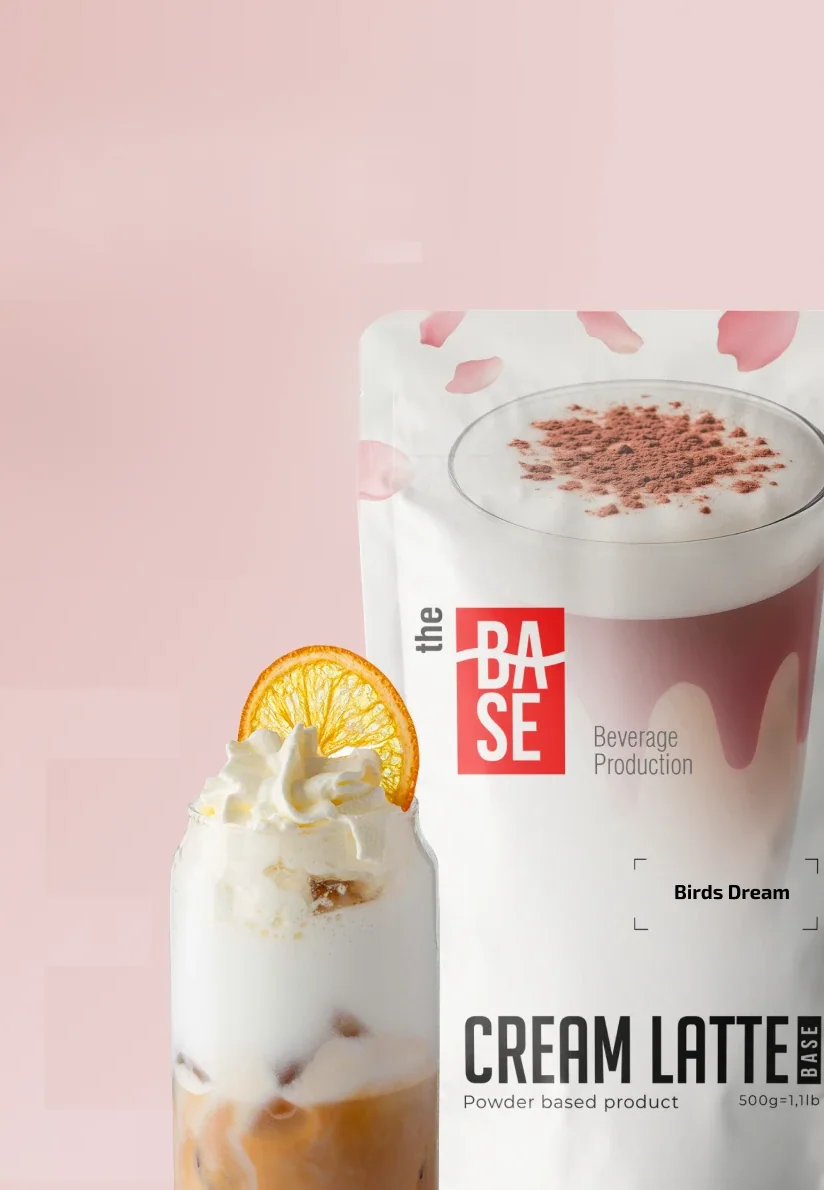
the Base makes dry beverage bases and pure powders in its own factory in the UAE. Production is Halal, HACCP and ISO 22000 certified. The range covers 600+ flavours across 24 product lines, from chai latte and frappe to iced tea, and is used in 5,000+ outlets in 26 countries. There is no minimum order, lead time starts from 15 days, and samples are free. Bases are medium sweet, work with plant milk and can be served iced. The team develops custom bases and signature drinks for chains, helps with menu development and runs masterclasses for groups of 20+.
FAQ
Is Halal certification required for beverage premixes in the UAE?
It is required for any product sold with a Halal claim, and most UAE distributors and HoReCa buyers expect it in any case. Check that the certificate comes from a body listed by MoIAT.
How many suppliers should a café test at once?
Two or three is enough. Test them on the same day, at the same dose and with the same barista so the comparison is fair.
Why does a local manufacturer matter for a UAE café?
Shorter lead times, no import step for the buyer, and the option to visit the production team or showroom to check products and recipes in person.
Request free samples at /contacts, or visit our showroom in Al Quoz Industrial Area 2, Dubai, Monday to Saturday, 9:00 to 18:00.